Thursday, March 6, 2014

Sri Lanka hits out at HC Navi Pillay and SG Ban ki-Moon and rejects the draft resolution

Excerpts form the speech of Minister G.L. Peiris at UNHRC on 5th March 2014
The High Commissioner’s Report has exceeded its mandate by making reference to and recommendations on numerous issues extraneous to the resolution. Additionally, the recommendations contained in the Report are arbitrary, intrusive and of a political nature, and are not placed within the ambit of the LLRC, as demonstrated by the call to establish an international inquiry mechanism. Further, this recommendation is in contravention of her mandate granted by GA Resolution 48/141, particularly Articles 3(a) and 4(g).

Wednesday, March 5, 2014

Report presented by SLMC to HC Navi Pillay: Religious Violence in Sri Lanka Jan 2013 – Dec 2013

SLMC leader Hakeem with HC Navi Pillay
An update of “Muslims’ Concerns” presented by the Sri Lanka Muslim Congress to the United Nations High Commissioner for Human Rights, August 2013

Key Information
1.    Over the 12 month period between January and December 2013 there were at least 241 anti-Muslim attacks andat least 69 anti-Christian attacks in Sri Lanka. 51 of the anti-Muslim incidents were violent, involving either physical violence against individuals or destruction of property. 15attacks against Christians were violent. There were no significant attacks against Buddhists and Hindus. 

Read the Annex 01 of incidents  as a PDF here

In a letter to the UN, Archbishop Emeritus Desmond Tutu, representing human rights activists, has appealed for a commission of inquiry in Sri Lanka

Archbishop Emeritus Desmond Tutu. (AFP)
We, concerned individuals and organisations from around the world, urge the United Nations Human Rights Council (UNHRC) to use their March 2014 session to pass a resolution that will include a commitment to an independent international investigation in the form of a commission of inquiry in Sri Lanka. Only this will help put the country on the path to justice and reconciliation.  Although the long-running civil war ended in May 2009, a lasting peace is not in sight and we remain gravely concerned for the future of the people of Sri Lanka. A fear and sense of injustice persists, not just among minorities and political activists, but among ordinary people desperately trying to rebuild their lives.

Time has come for the Council to establish its own international inquiry mechanism on Sri Lanka - HC Navi Pillay in her annual report

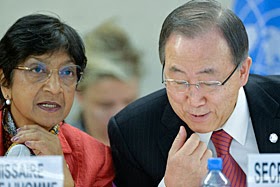
Navi Pillay and Ban ki-Moon at the opening session
Opening Statement by Ms. Navi Pillay, United Nations High Commissioner for Human Rights
 
(to be delivered on 6 March 2014)
Impunity and the rule of lawStrengthening the administration of justice remains a priority for OHCHR, with focuses on such fundamental issues as the independence of the judiciary and the protection of the rights of persons deprived of their liberty. We continue to support human rights mechanisms that specifically address these issues. My Office has also continued its advocacy in favour of a moratorium on the death penalty, with the goal of its complete abolition.  I am heartened to note that the list of countries which have abolished this cruel measure, or adopted a moratorium, is growing constantly.

The ‘Census on human and property damages due to conflict - 2013’ will not reveal the true extent of death, disappearance and damage caused by the war - CPA

Commentary on the Census on human and property damages due to conflict 2013 by CPA
Executive Summary
The results of the ‘Census on human and property damages due to conflict - 2013’ are due to be published in March 20141, in time for the 25th session of the UN Human Rights Council in Geneva from 3 - 28 March 2014. However, despite the Director General of the Department of Census and Statistics claiming that this census will “help arrive at an exact decision on the persons missing and died during the period of conflict in the country”, it is evident from the methodology juxtaposed against the fear and intimidation people feel in the Northern Province alone, that the ‘Census on human and property damages due to conflict - 2013’ will not reveal the true extent of death, disappearance and damage caused by the war.

Tuesday, March 4, 2014

Sri Lanka’s victims dismayed by draft resolution at UNHRC - BTF

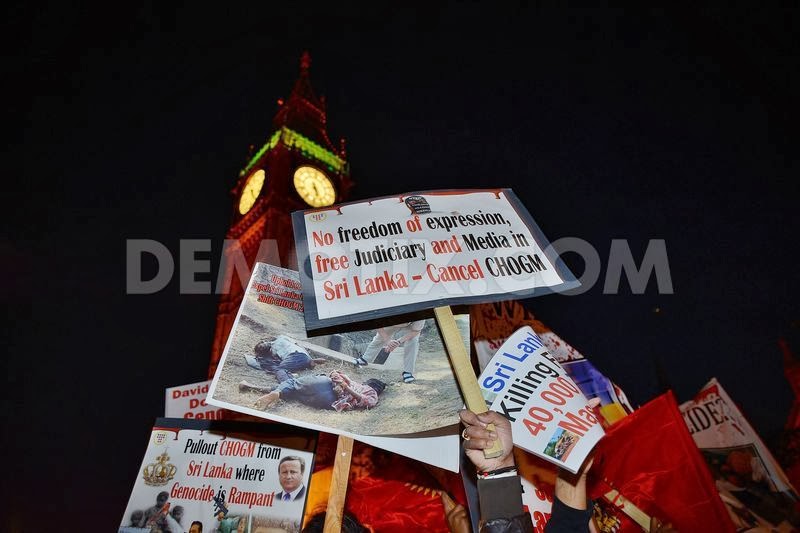
BTF led demo in London ( click to enlarge)
The insubstantial draft resolution on Sri Lanka that was released yesterday at the United Nations Human Rights council (UNHRC) has greatly disappointed and shocked the Tamil people, who are the primary victims of the ongoing conflict in the Island of Sri Lanka. The resolution text effectively calls for more of the same: it requests another update by the Human Rights Commissioner in a year’s time and makes another call on Sri Lanka to launch a credible domestic inquiry – despite the Human Rights Commissioner herself declaring that Sri Lanka has no political will to investigate itself.

Sri Lanka: Draft rsolution shows that USA and UK are determined to see the structural genocide of Tamis completed - Tamil Net

Vanni, Sri Lanka during the war, 2009
US draft stops at Navi Pillai inquiry into HR crimes of ‘both parties’ by TamilNet
A draft resolution on Sri Lanka that is to be tabled at the UNHRC later this month by the USA, UK, Montenegro, FYR of Macedonia and Mauritius was put to circulation on Monday. Contrary to the trumpeting by sections among Tamils expecting US-UK justice through international investigation on war crimes, the draft just harps on OHCHR investigation into “alleged violations and abuses of human rights and related crimes by both parties in Sri Lanka.” On the other hand, the draft that fails in recognising Tamils even by name not only provides more space and time for the completion of their structural genocide but also binds the UNHRC with supporting the “unified land” of the genocidal State.

Establisht an international mechanism for inquiry into HR abuses ,accountability and war crimes - Sri Lanka Civil Society

The increasing authoritarianism of the government is a fact
JOINT CIVIL SOCIETY MEMORANDUM TO THE HUMAN RIGHTS COUNCIL AND THE INTERNATIONAL COMMUNITY
We recognize the framework agreed upon in resolutions 21/1 HRC (2012) and 22/1 HRC 2013 supporting reconciliation and accountability in Sri Lanka and efforts made by member states calling on the Sri Lankan government to address grave violations of human rights and humanitarian law committed before, during and after the war which ended in May 2009. We recognize too the efforts of member states calling on the Sri Lankan government to address continuing violation of human rights and democratic norms in Sri Lanka.

A new report documents incidents of rape, torture, arbitrary arrest and murder in Northrern Sri Lanka

The Sri Lanka Campaign for Peace and Justice has today released a report that presents credible allegations pointing to the commission of crimes against humanity by Sri Lankan security forces during the five years since the civil war ended. These crimes include rape, sexual violence, torture, murder, imprisonment, enforced disappearance, other inhumane acts, and land grabs against Tamil civilians in the Northern Province. Various sources, including a Panel of Experts commissioned by UN Secretary General Ban Ki Moon, have found credible allegations of crimes against humanity committed by both government forces and the LTTE during the civil war.

Nine bodies, mostly women, found on Sri Lanka’s last battlefield

unearthed bodies of Mullaitivu mass grave
Reuters
Nine bodies, most of them women, have been found in a mass grave in Sri Lanka in the area where the last, bloody battle of a 26-year war with Tamil separatists was fought in 2009. International pressure is growing on Sri Lanka’s government to address allegations that tens of thousands of civilians were killed by the army in the final weeks of the war. The United States plans to put forward a resolution criticizing Sri Lanka at this month’s session of the U.N. Human Rights Council, and U.S. officials have said it may call for an international investigation.

The “systemic failure in Sri Lanka sited as one reason for UN SG Rights Up Front initiative

UN SG speaks at HRC on 3rd March 2014
Rights Up Front
"Rights Up Front" Action Plan was launched by the Secretary-General in 2013, and it aims to enhance the United Nations response to situations where people are at risk of, or are subject to, serious violations of human rights, in accordance with the Organisation's obligations under the Charter.
Promoting and encouraging respect for human rights is a core purpose of the United Nations and defines its identity as an organization for people around the world.

Member States have mandated the Secretary-General and the UN System, through the Charter and successive General Assembly resolutions to help them meet the standards expressed in the Universal Declaration of Human Rights

Monday, March 3, 2014

Sri Lanka: Draft calls for UN backed probe

Moon hailed Pillay report which calls for CoI ( File photo)
A first draft of the third and toughest US sponsored resolution on Sri Lanka at the UN Human Rights Council calls for an investigation into alleged abuses by both parties to the conflict to be led by the Office of the High Commissioner for Human Rights (OHCHR) Navi Pillay. The draft resolution which was in circulation yesterday, rules out an investigation by a Commission of Inquiry, but sets the stage for a Pillay-led probe to be supported by findings of special procedures mandate holders – or special rapporteurs.
The resolution in its initial draft has opted for the OHCHR inquiry mechanism, one of the investigative processes available to the Council to hold the Sri Lankan Government to account over mounting allegations of rights abuses.

India for 'much more progress' in reconciliation in Sri Lanka

Singh to meet Rajapaksha
Press Trust of India   
India today made it clear that it looks for "much more progress" in the reconciliation process in Sri Lanka while being non-committal on how it will vote at the UN Human Rights Council on a resolution on the country's alleged rights abuses during the war with Tamil Tiger rebels.
"India's approach is that it looks for much more progress in the reconciliation process," official sources of the Indian side said here.

Draft resolution on Sri Lanka as received by UN Human Rights Council Members

UNHRC in 25th session ( UN photo)
Draft resolution on Sri Lanka as received by Human Rights Council Members
25/1. Promoting reconciliation, accountability, and human rights in Sri Lanka The Human Rights Council,
Reaffirming the purposes and principles of the Charter of the United Nations,
Guided by the Universal Declaration of Human Rights, the International Covenants on Human Rights and other relevant instruments,
Bearing in mind General Assembly resolution 60/251 of 15 March 2006,
Recalling Human Rights Council resolutions 5/1, on institution-building of the Council, and 5/2, on the code of conduct for special procedures mandate holders, of 18 June 2007,

Commissions of Inquiry have highlighted massive violations which demand engagement by the Security Council and ICC - Navi Pillay

Remarks by the High Commissioner for Human Rights to the opening of the twenty-fifth session of the Human Rights Council
3 March 2014
“Today I address this High-Level Segment of the Council for the last time as High Commissioner for Human Rights. I do so acknowledging the many achievements of the Human Rights Council. The significance of this Council’s work is reflected in the fact that up to 100 Ministers will participate in this Council’s session. We are particularly honoured today by the presence of the President of Tunisia, whom I wish to warmly welcome. This 25th Session of the Human Rights Council launches an ambitious year of activities to promote and protect human rights of all people everywhere and strengthen human rights mechanisms in all countries.

Tamil Christian Clergy from North-East Sri Lanka call for an international investigation

Against the land grab - Vikalpa photo
Tamil Christian Clergy from North-East Sri Lanka call for an international investigation mechanism from the UN Human Rights Council
Before the 19th and 22nd sessions of the UN HRC, some of us, as Tamil Christian clergy serving in the war ravaged North and East of Sri Lanka, wrote to the members of the UN HRC, appealing to appoint an international mechanism to look into allegations of violations of international humanitarian and human rights law, during the war in Sri Lanka. We have experienced, heard and seen indications of numerous such allegations. Our own experience and knowledge correspondent to the findings and recommendations of the UN Panel of Experts, the UN High Commissioner for Human Rights and well known Sri Lankan and international human rights organizations.

Sunday, March 2, 2014

Let the U.N. Unmask the Criminals of Sri Lanka’s War

By LOUISE ARBOURFEB.
BRUSSELS — IN early 2009, as many as 40,000 civilians were killed in the final days of Sri Lanka’s civil war, having been herded into an area about the size of Central Park and subjected to relentless shelling. No one has been held accountable for these crimes, and even now the government in Colombo remains intent on burying the past. Only an international commission of inquiry stands any chance of rectifying this omission. So when the United Nations Human Rights Council meets Monday in Geneva, it should seek an investigation. It would be a decisive step toward justice and reconciliation in Sri Lanka.

New law to help families of missing people :Certificate of Absence, instead of Death, to restore their rights


Painting by C. Thenuwara,
photo Vikalpa
Namini Wijedasa
The Government is drafting legislation to grant a ‘certificate of absence’ to relatives of the missing who do not want to accept certificates of death for their loved ones, a senior official said yesterday.  The certificate of absence—which has never before been issued in Sri Lanka but is used in several other countries with large numbers of missing people—will entitle the holder to the same rights enjoyed by the holder of a certificate of death. The committee overseeing implementation of the LLRC recommendations has given a proposal to the Ministry of Public Administration which will seek Cabinet approval, committee member and Technology Ministry Secretary, Dhara Wijayatilake said. It will go through the draft stage and will be presented as a bill to Parliament.

Cost of living more worrying than Geneva issues, BT poll

Sri Lankans are more concerned about cost of living and making ends meet than any international issues, was one comment received when the Business Times (BT) sought the views of people on the US-backed resolution against Sri Lanka at this month UN Human ights Council meeting in Geneva
Below is cross section of the comments received in the email poll.
On whether the resolution  would create chaos:
- No one is concerned about the resolution. Why should they be? 60 per cent of our population is worried about how to pay for the next meal or feed their children.
- There will certainly be an immediate reaction from the Government and more particularly the extreme elements.

GoSL response to Pillay report failed to argue in Sri Lanka’s favour

Sunday Times Editorial: Geneva: Be substantive, not combative Slowly but surely, the dreaded United Nations Human Rights Council (UNHRC) sessions have stealthily crept up. A resolution against Sri Lanka — sponsored by the US and promoted by Britain and India — is on the cards this month. With the solitary backing of China from among the big and powerful nations, it would be a Herculean task to defeat the resolution in the 47-member Council.

Sri Lanka: TNA passes resolution against Commission on Disappearances

Commission sittings in Kilinochchi
KilinochchiKilinochchi
Kilinochchi
Kilinochchi
The Tamil National Alliance (TNA) has passed a resolution denouncing the Presidential Commission to Probe Disappearances, while confirming its support to the US-sponsored resolution to be brought at the UN Human Rights Council (UNHRC) sessions in Geneva.A special gathering of the top brass of the TNA, including its Parliamentarians and Provincial Councillors representing the North and East, took place at the Jaffna Public Library auditorium on Thursday (27).

Saturday, March 1, 2014

Sri Lanka: Second US Senate resolution calls for S. African style mechanism

In the wake of a group of US Senators calling for the establishment of an independent international accountability mechanism to investigate wartime atrocities as well as other human rights abuses, another group of Senators is proposing a Truth and Reconciliation Commission (TRC), similar to the one set up by South Africa, to address grievances of those who had been effected by the Eelam conflict.

Sri Lanka family finds mass grave in garden in former war zone

Matale mass gave had 154 skeletons
AFP – Colombo: A Sri Lankan family has stumbled upon the remains of at least nine bodies buried in the garden of their home, police said Saturday, the latest mass grave to be discovered in the country’s former war zone. The family made the grisly find on Friday while clearing out their garden in the town of Puthukkudiririppu in the northern district of Mullaittivu, police spokesman Ajith Rohana said.
“Remains of nine people had been found so far and the skeletal remains were taken for analysis by the judicial medical officer in the area,” Rohana told reporters.

Red Cross to conduct Sri Lanka disappearance survey

 Press Trust of India
A needs assessment survey in Sri Lanka for families of individuals who disappeared during the nearly three-decade long civil war in the country will be carried out by the International Committee of the Red Cross.
The survey would begin in April and is scheduled to get completed by the end of the year, said Sarasi Wijeratne, ICRC's spokesperson. The ICRC has received 16,000 complaints of disappearances since 1990.

Channel 4 publishes 'The Uncorrupted Truth' on war crimes in Sri Lanka

Channel 4 has today taken the unprecedented step of publishing a detailed refutation of “an international propaganda offensive” launched by supporters of the Sri Lankan government against its reporting of events at the end of Sri Lanka’s bloody civil war. Channel 4’s News and Current Affairs journalists have led the way in exposing the country’s war crimes, culminating in the broadcast of the feature length documentary No Fire Zone - a forensic investigation into the final weeks of the bloody civil war in Sri Lanka.